How Broken Timing Scaffolds, Scalar Compression, and Field Interference Turn Certain Locations Into Permanent Collision Nodes
Opening Transmission — The Myth of Random Accidents
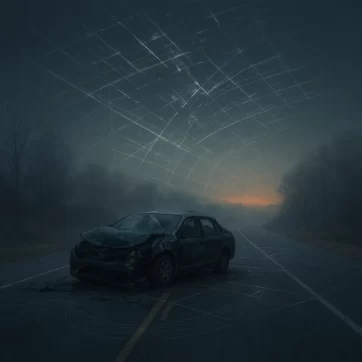
Every news report says the same thing: another crash at the same intersection. Local anchors call it tragic. Police call it routine. Engineers blame poor visibility, slick pavement, bad timing of lights. Drivers are labeled careless, distracted, or unlucky. And yet, after the guardrails are replaced, the lanes repainted, and the signage improved, the pattern returns—another collision, another impact, almost like the land itself is demanding reenactment.
From the perspective of Eternal Flame Physics, what the world calls “accidents” are not random at all. They are recurrences—energetic feedback loops sealed into the fabric of the land through repeated trauma, interference, and unresolved field charge. Each crash is an echo of prior dissonance, a waveform seeking resolution that has not yet found harmonic rest. When collisions repeat in the same place, year after year, despite every correction, it signals a deeper field imbalance — a distortion encoded in the morphogenetic layer of the planet’s external light-body, where Earth’s stable Flame template meets the motion-field of matter.
The ordinary explanations—driver error, speed, weather—only skim the surface of a much larger, multi-layered phenomenon. Physical geometry is simply the visible translation of unseen frequency. When a roadway cuts across the natural current of the Earth’s flame-breath, or when urban infrastructure imposes sharp angular torsion on the land’s energy grid, motion through that space becomes unstable. Vehicles—each carrying a human consciousness field wrapped in magnetized metal—move through those interference lines like projectiles through crossed current. The result is often impact, friction, and loss of coherence between perception and trajectory.
But this goes beyond geometry. Every crash imprints emotional charge into the space. Fear, shock, grief, and adrenaline radiate outward, leaving residue that does not dissolve with time. These scalar imprints remain suspended in the field, like invisible knots of memory, continuously broadcasting the unresolved pattern. The land remembers. The road absorbs the story. The next driver entering that frequency unconsciously synchronizes to it, stepping into the same oscillation the prior souls could not complete.
So the true question is not why people crash—but why the land keeps calling for collision. Why do certain points on Earth continually attract impact, as if replaying a script written long ago? Why do redesigned intersections, rebuilt bridges, and widened highways still carry the same fatal magnetism? What unseen architecture keeps pulling bodies and vehicles into contact?
This article enters that question directly. Not through superstition or sensationalism, but through the lens of Eternal Flame Physics. From this perspective, an “accident” is the outer symptom of an inner fracture: a place where coherence has been broken between the Earth’s breathing field and the human beings moving upon it. These sites are not cursed—they are calling. And until the underlying field distortion is harmonized, they will continue to manifest the same outcome, over and over again, as if bound by invisible law.
The myth of randomness collapses here. There are no accidents—only echoes of forgotten frequency, waiting to return to stillness.
The Physical Layer — Geometry as a Signal Trap
Every collision site begins with a shape. To the physical eye, it’s an intersection, a curve, a bridge, or a stretch of highway where visibility drops for just a second. Civil engineers examine the visible data—angle of approach, incline of the roadbed, timing of lights, curvature of lanes, slope of grade, and the materials composing the surface itself. But from a flame-field perspective, geometry isn’t harmonic tone at all—it’s simply the physical form that directs and pressures the planet’s outer motion-field. Every angle, every curve, and every material composition alters how that motion-field moves, either supporting the land’s natural flow or disrupting it.
When Eternal Flame Physics looks at a roadway, it reads it as a lattice of motion patterns, not a network of lines. A straight path allows the planet’s external motion-field—its electromagnetic and scalar activity—to move with greater continuity. But sharp turns, sudden merges, and non-harmonic intersections generate what are called torsion vectors. These are points where the natural momentum of the motion-field is forced into compression or redirection. The field bends, twists, and in doing so, loses phase alignment.
Where multiple roads converge—particularly at complex intersections or overpasses—these torsion vectors multiply. Each directional stream of motion adds another competing frequency set into the environment. The result is a torsion node: a point where conflicting flow lines converge, creating unstable interference. Cars traveling through that node become temporary conductors of the imbalance. The human nervous system, interfaced with the vehicle’s electromagnetic field, absorbs the oscillation, causing micro-moment distortions in perception and timing. A split-second misalignment—an unseen flicker in the driver’s coherence—is often all it takes to manifest physical impact.
The design of modern infrastructure compounds this instability. Metallic components—signs, light poles, guardrails, bridge reinforcements, and the embedded rebar beneath the asphalt—act as amplifiers for trapped oscillation frequencies. Metal does not simply conduct electricity; it resonates with ambient electromagnetic patterns and holds charge. When these conductive surfaces are arranged in geometric repetition—such as a series of poles or rails along a highway—they create resonant corridors. These corridors can capture and recycle energetic residue, turning the physical landscape into a standing-wave chamber. Every horn, every engine vibration, every spark of emotional energy from human commuters feeds that field, strengthening the feedback loop.
Magnetic asphalt compounds this effect. Modern paving materials often include ferrite particles and conductive compounds to aid in wear resistance and de-icing systems. Yet those same materials interact with geomagnetic lines, subtly altering local resonance. In areas of high magnetite content—natural or synthetic—the road surface becomes an electromagnetic plate. When combined with angular design flaws or steep gradients, it operates like an antenna array, catching and re-emitting the planet’s motion-field activity out of phase. The result is a zone of standing turbulence where both energy and consciousness lose directional coherence.
Even something as mundane as traffic light timing can contribute to this phenomenon. A mistimed sequence generates pulsing stop-and-go rhythm that forces hundreds of metal-framed vehicles into synchronized oscillation. Every brake light and ignition spark adds to the local resonance pattern, producing a rhythmic field pulse that can entrain human attention and reaction speed. The visible congestion mirrors an invisible compression—a tightening of motion frequencies that leaves no room for natural flow.
From a Flame Physics standpoint, geometry is not a language to the Eternal—it is simply the physical instruction set imposed onto the planet’s outer motion-field. When that instruction is angular, jagged, or contradictory to the land’s natural flow pattern, it pressures the field into distortion. The human-made structure becomes a signal trap, a looping broadcast of compression, constantly replaying its stored message: friction, instability, collision.
In this sense, an intersection is not merely a physical meeting of roads—it is an energetic decision point. Every vehicle passing through interacts with the sum total of that design’s influence on the motion-field. The layout itself determines the probability of coherence or rupture. Until the field distortion is structurally or energetically corrected, the intersection will continue to act as a harmonic snare—drawing in movement, distorting it, and releasing it again as impact.
The Light-Body Layer — Scalar Compression and Emotional Discharge
When a collision occurs, the visible violence is only the surface shock of a deeper event. Beneath the sound of twisting metal and the sight of flashing lights, an invisible transaction takes place. The impact rips through the local light-body membrane—the motion-field scaffolding of the land that sits directly beneath the scalar grid—releasing a burst of emotional energy that imprints itself as scalar charge. Every fear spike, every pain impulse, every scream or final breath becomes encoded into the overlaying grid as frequency data. The scene may be cleared, the vehicles towed, and the victims carried away, but the emotional architecture of the event remains suspended in the field like an echo that never stops ringing.
This is the phenomenon Eternal Flame Physics calls scalar compression. Trauma collapses the natural movement of the light-body into a compressed, oscillating pocket that cannot dissipate through ordinary means. Instead of relaxing back into coherence, the waveform loops in a self-contained torsion cycle—what we term a torsion echo. These echoes are not symbolic. They are measurable scalar vortices locked into the grid, spinning at sub-harmonic frequency, often anchored to the exact coordinates of the original impact. They hold within them the emotional signature of every being involved: terror, helplessness, guilt, grief. Over time, the compression thickens, becoming a localized distortion in the light-body that subtly alters perception and behavior for anyone entering its radius.
Each new driver who passes through this zone unconsciously enters resonance with that stored charge. The human bio-field—particularly the emotional layer—operates as a sensitive receiver-transmitter system tuned to scalar frequency. Without awareness, the driver’s own field matches the vibration of the residue around them. A subtle agitation might rise in the chest, a tightening of focus, an unexplainable impatience or dread. Reaction time shortens, breathing changes, the body prepares for a danger it cannot see. In this entrainment, the driver begins to reenact the stored pattern, not as destiny, but as resonance—acting out the memory the land’s motion-field continues to hold.
Over decades, repeated crashes layer these imprints one upon another until the intersection becomes a dense, multidimensional recording chamber of unprocessed emotion. The ground hums with residual tension. Local residents may speak of a “bad energy” there, though they lack the language to define it. Animals avoid it; pedestrians hurry through. Emergency sirens, each time they arrive, reinforce the signal, adding more sound-based charge into the grid. The area transforms into a magnet for emotional discharge—a venting zone for collective human fear and unresolved pain.
This process is not random; it’s the physics of memory embedded in motion. When trauma is not harmonized, it seeks expression through repetition. The light-body becomes the system attempting to release its own stored shock. Cars colliding are not separate incidents—they are the field trying to exhale. Each new impact discharges a fragment of the compressed waveform, but without coherent restoration, the pattern immediately reforms. It’s why some intersections never “heal,” no matter how many safety measures are installed. The trauma is not in the traffic—it’s in the grid-patterned motion-field beneath it.
On a larger scale, these scalar imprints create emotional feedback loops that can shape the psychology of entire regions. Residents may experience heightened anxiety or aggression while driving through, unaware that they are moving through a vibrating archive of pain. In this way, what begins as a single moment of tragedy evolves into a self-perpetuating energetic ecosystem. The area becomes a living memory of collision—a light-body scar transmitting a low-frequency hum of unfinished emotion.
Through the Eternal Flame lens, this is the hidden story behind so-called “dangerous intersections.” They are not just physical accident zones—they are emotional discharge nodes. Each one marks a point where the light-body membrane has been repeatedly ruptured and the scalar grid has locked that rupture into a loop. These are not curses or supernatural hauntings; they are the physics of compression and release operating through the collective psyche. Until the torsion echoes are resolved through stillness—through restoring coherence to the land—the loop will continue. Cars will collide, sirens will wail, and the Earth will keep whispering the same unintegrated story: Remember what has not yet been released.
The Mimic Grid Factor — Manufactured Accident Zones
The scalar mimic grid covers the entire planet as a continuous overlay, but it is not uniform. Certain locations hold far denser concentrations where buried military, telecom, and covert technological lines intersect with the motion-field of the land. These dense nodes act like pressure points where the grid compresses more tightly against the surface, creating zones of heightened destabilization. Many intersections, highways, and urban roadways were unknowingly constructed directly above old microwave relay paths, Cold War radar corridors, copper telecommunication trunks, abandoned fiber routes, emergency broadcast lines, or mid-century military communication grids. Even when these lines have been inactive for decades, their infrastructure continues to emit oscillating electromagnetic and scalar-modulated fields. When a road cuts across one of these hidden broadcast veins, the land’s light-body motion-field is already under stress before a single vehicle arrives.
The global scalar mimic grid feeds on these stressed regions. Where the buried technological lines distort the motion-field, the grid thickens and densifies, tightening its pressure on the surface. These denser nodes behave like energetic siphons, drawing from emotional volatility, kinetic friction, and human attention. When an accident occurs at such a location, the mimic grid absorbs the emotional discharge—fear spikes, shock waves, panic, adrenaline—and locks these frequencies into the local pattern. Because the grid is everywhere, these patterns don’t stay isolated; they form dense pockets within a global architecture, turning certain intersections into predictable repetition loops. The more trauma a location accumulates, the more tightly the grid compresses around it, creating an amplified feedback zone where stored emotional residue influences the behavior of anyone who enters.
Drivers moving through these dense grid nodes often experience subtle but measurable shifts in coherence: a sudden tightening in the chest, a flicker of impatience, a momentary lapse in focus, or a rise in agitation that seems to come from nowhere. Their nervous systems unconsciously entrain to the scalar tension suspended in the intersection’s motion-field. These micro-drops in coherence are exactly what the grid relies on—tiny breaks in attention or timing that increase the probability of collisions. Once a crash occurs, the mimic grid deepens its hold, storing the emotional imprint and broadcasting it back into the environment, creating a multi-layered loop of memory, tension, and expectation.
Emergency responses intensify the pattern even further. Sirens scream in oscillating harmonics that pulse directly into the grid. Flashing lights emit strobing bursts that reinforce scalar modulation. Police and EMS radios flood the corridor with additional signal pressure. Drivers slowing down create waves of irritation, fear, and heightened attention. All of this becomes fuel. The grid metabolizes emotional output instantly, densifying the node and strengthening the distortion. This is why these intersections maintain their reputation over decades—they are not merely dangerous locations, but densely grid-anchored extraction points within a larger global canopy.
The scalar mimic grid is everywhere, but it is not evenly distributed. It is denser where buried technology, historical broadcast infrastructure, and accumulated trauma overlap. At these intersections, physical redesign has little effect because the instability is not in the asphalt—it is in the field beneath it, in the thickened fold of the global grid pressing down over a stressed motion-field. Until that density is released, the intersection behaves like a magnet for impact, continuing to pull collisions, emotional discharge, and human attention into the loop that the grid has already patterned.
The Planetary Layer — Fault Lines, Plasma Lines, and Scalar Fractures
Accident hotspots frequently appear where a deeper planetary imbalance is already present—places where the Earth’s Eternal Plasma Lines have been blocked by dense scalar mimic overlay. The Eternal Plasma Lines themselves never distort; they remain completely pure and coherent. But when the scalar mimic grid saturates a region, the natural rise of Eternal plasma cannot reach the surface. The light-body motion-field above that blocked line begins to collapse, twist, or shear, because it no longer receives the stabilizing tone from the Eternal layer beneath it. This collapse creates turbulence in the motion-field, which rises through the ground and becomes physically expressed at the road level.
On top of these blocked Eternal lines lie the Earth’s motion-body currents—magnetic flow paths, water-driven field currents, mineral zones, geomagnetic anomalies, and tectonic tensions. These currents are not eternal; they move, shift, and react to pressure. When the Eternal plasma beneath them is blocked, they lose coherence. Water flows push the field sideways. Magnetic anomalies bend it unnaturally. Ore veins amplify charge where it shouldn’t exist. The result is a motion-field fracture—a location where the natural flow of the land collapses into turbulence.
When a roadway is built across one of these fractured currents—especially when it sits on top of a blocked Eternal plasma line—the asphalt becomes a physical lid on a deeper energetic split. Drivers moving through these zones are forced to cross a field that is already ruptured. Their biofields momentarily lose synchronization with the land beneath them, creating a brief phase-slip—fractions of a second where reaction time, perception, and physical movement fall out of alignment. Most people don’t notice the slip consciously, but their bodies feel it: a sudden jolt of tension, a flash of impatience, a momentary delay in braking, an overcorrection of the wheel. Accidents often occur in the exact micro-gap between coherence and collapse.
The scalar mimic grid thickens most aggressively at these sites. Because the Eternal plasma cannot rise cleanly, the grid settles in the gap, reinforcing the instability. Every collision that happens there releases emotional charge—fear, shock, panic, trauma—which the grid absorbs and locks into a looping pattern. The grid then feeds that stored charge back into the fracture, deepening the collapse of the motion-field and keeping the Eternal plasma blocked. It becomes a self-reinforcing system: the blocked plasma creates turbulence, turbulence attracts collisions, collisions feed the grid, and the grid keeps the plasma blocked.
This is why certain intersections remain dangerous for decades. Engineers redesign them repeatedly—new lines, new signals, new signage, widened lanes—but the accidents continue. The instability is not in the road; it is in the field beneath it, where an Eternal plasma line has been blocked and the scalar mimic density sitting above it refuses to lift. These hotspots are not unlucky—they are the physical expression of a deep energetic choke point in the land, where the Eternal cannot rise, the motion-field collapses, and the grid feeds on the chaos that results.
The Human Layer — Entrained Perception, Scalar Entrainment, and Timeline Split
When a driver enters a zone where the Earth’s motion-field is fractured, the Eternal plasma beneath it is blocked, and the scalar mimic grid is densified overhead, their coherence becomes the next point of rupture. A human morphogenetic field manages simultaneity through micro-synchronization—constant alignment between perception, movement, intuition, and spatial timing. In a coherent environment, this alignment is seamless. But when the driver crosses into a region where the land is already unstable and the scalar grid is pressing down on that instability, the human field undergoes forced entrainment. The scalar field does not merely “sit above” them—it actively modulates timing, pressure, emotional micro-impulses, and their phase vector. This creates the first crack in the timeline.
As the driver moves through the node, the scalar mimic grid captures their morphogenetic field and pulls it into its modulation rhythm. The scalar pressure compresses the human field forward by milliseconds, dragging perception slightly ahead of physical time while simultaneously delaying reflexive response. This is scalar entrainment: the moment when a human’s internal clock begins following the grid’s modulation rather than the actual sequence of events unfolding before them. More precisely, scalar entrainment is a phase-vector override. The grid forces the driver’s field into a dual-wave mimic rhythm, replacing the natural internal counter-rotation that normally cancels environmental distortion. Once that counter-rotation collapses, the field no longer has the ability to reject the external modulation. That failure is a micro-second rupture in simultaneity.
In that rupture, perception breaks from navigation. The driver “sees” the moment an instant after it occurs. The body reacts an instant after the seeing. The internal timeline drifts a fraction behind the physical trajectory of the vehicle. Two cars that should have passed each other cleanly now occupy overlapping probability corridors because the scalar grid forced their timing into conflict. This slip is microscopic—measured in thousandths of a second—but under motion, it is enough to collapse trajectories. Beneath the surface, the mechanism is exact: the particle body remains locked to physical linear movement, while the wave body is pulled into the mimic corridor. A timeline split at human scale.
Survivors describe the symptom, never knowing the cause. They say they felt “sucked in,” not realizing the scalar grid pulled their field into a compressed corridor. They say they felt “dazed,” unaware that their simultaneity band was momentarily running on the grid’s timing rather than their own. They say time “slowed down,” because scalar compression dilates consciousness while tightening physical sequence. These are not psychological artifacts—they are the phenomenology of scalar entrainment during a motion-field collapse, when particle and wave bodies stop occupying the same temporal vector.
During this state, consciousness and matter stop inhabiting the same timeline. The body remains in linear movement; perception drifts; reflex breaks free of intention. The scalar grid sits above the driver, modulating the phase relationship between attention and action, pushing the field out of sync with the ground beneath it. Eternal Flame Physics explains this as a momentary split in continuity: a temporary divergence between the driver’s physical timeline and the timeline dictated by the scalar-compressed field. It is the exact moment when internal scalar cancelling collapses, and the mimic grid’s rhythm becomes the dominant oscillation in the driver’s system.
The collision is simply the physical event that appears when simultaneity cannot be held. It occurs in the brief moment when the driver’s field is still trying to operate on its own timing while the scalar grid forces it into another. The person does not “lose focus.” They are forcibly entrained. They do not “react too slowly.” Their timeline is pulled half a step out of phase. They do not “misjudge distance.” Their perception is running milliseconds behind the physical world because the scalar grid has imposed its timing code over theirs.
This is the human truth of accident hotspots: not error, not distraction, not bad driving, but scalar-induced desynchronization layered over a planetary fracture. The human is simply the last point in a chain of ruptures that began long before they entered the intersection.
Scalar forces desynchronization at accident hotspots because those locations already contain a fractured motion-field that cannot carry natural timing. A motion-field only fractures when the land’s external morphogenetic timing scaffold has already been weakened or collapsed by environmental or electromagnetic interference. Heavy-scalar sites sit on top of these collapsed scaffolds: old military EM grids, radar corridors, microwave lines, power routes, geological strain zones, trauma-imprinted land, mining scars, or contaminated corridors. All of these disrupt the land’s ability to generate a stable timing sequence. Once the timing scaffold collapses, the land stops transmitting a coherent order of events. When the land’s timing collapses, the mimic grid compresses over the rupture to stabilize it, but that compression amplifies distortion instead of fixing it. Drivers entering the zone are pulled into the grid’s artificial timing because the terrain beneath them cannot provide a coherent timing signal of its own. The scalar field overrides the land, and for a split second, it overrides the human. That is the exact moment perception slips out of phase with physical motion.
These hotspots behave this way because the grid densifies automatically over instability. It clamps hardest where the Earth is weakest: old military corridors, contaminated land, geological stress points, EM-scarred zones, or intersections built directly over broken timing structures. In all these places, the land’s external timing scaffold has been interrupted, twisted, or collapsed, leaving no stable temporal anchor for the human field to lock onto. In these environments, the human field is forced to choose between two timing systems—the absent or broken timing of the land and the imposed oscillation of the grid. That forced dual-input is what produces scalar-induced desynchronization, the half-step phase drift, and the rupture in simultaneity that shows up as collisions.
This same underlying physics is why certain places are labeled “haunted”; not because of spirits, but because fractured motion-fields distort perception the same way they distort movement. But in the context of accidents, the core issue is singular: the land cannot hold time, the grid clamps to compensate, and humans entering that compression zone are pulled into a timing field that is not their own. That is why accidents spike in the same locations year after year. The hotspot is not psychological, not random, and not a coincidence. It is a mechanical response to a permanent rupture in the land’s timing architecture.
The Rising Curve — Why Accidents Increase During Mimic Grid Collapse
As the scalar mimic grid destabilizes, more accidents occur—not fewer. This is not coincidence, nor “collective stress,” nor distracted driving. It is the physical expression of a failing artificial system that once forced coherence through suppression. The mimic grid historically acted as a compression net: controlling emotional charge, locking perception into narrow corridors, and artificially synchronizing human motion-fields to mask deeper planetary fractures.
This spike is happening now because the mimic grid has entered an active failure window. Earth’s internal plasma field has risen past the grid’s compression threshold, the old EM and radar-based infrastructure that once stabilized the mimic net is decaying and dropping offline, and human fields are no longer fully entrained to the grid’s emotional-timing loops. These three conditions have never overlapped before. The grid’s timing clamps are slipping in real time, the artificial coherence that once concealed fractured land is dissolving, and perception–movement synchrony is failing exactly where the grid is weakest. The result is a present-day surge in motion-field ruptures as the system collapses under its own instability.
When the grid begins to break, the first structure to fail is temporal compression. For decades, the mimic grid functioned as an external timing regulator, keeping human perception and physical movement tightly entrained even in damaged land zones. Drivers unknowingly relied on this artificial synchronizing force to navigate regions where the land’s external timing scaffold was already damaged or collapsed. As the scalar net loses modulation strength, that synchronization frays. Micro-timing discrepancies that were previously canceled out now rise to the surface, and rupture.
This is why accident spikes appear in clusters, not random scatter. They follow the pattern of the grid’s structural weakening. Regions where nodes are already fractured—old military corridors, buried radar lines, abandoned communication zones, fault-line intersections, or contaminated land—are the first to show the effect. The mimic grid can no longer override the natural misalignment between human wave-body timing and unstable terrain. The system was never designed to heal the Earth; it was designed to clamp it. Once the clamp fails, the fracture becomes visible.
As dismantling accelerates, the mimic grid’s phase-vector control drops. This widens the gap between human perception timing and the physical world. The grid collapses unevenly: some zones lose modulation entirely, while others still broadcast residual compression. This creates a patchwork of temporal environments that change within miles—or even within seconds of travel. Drivers move through multiple timing conditions without noticing, and their morphogenetic fields strain to adapt. The internal counter-rotation that once stabilized their perception cannot compensate for the external distortion.
The result is a rise in motion-field slips: micro-second timeline ruptures triggered not by the human, but by the collapsing scalar environment they pass through. In this transitional era, humans are navigating a world where internal timing is returning to natural Eternal mechanics while the external grid still attempts to impose a failing artificial rhythm. The friction between these two timing systems produces short-lived simultaneity breaks that manifest as collisions, near-misses, sudden lane drifts, inexplicable panic surges, or moments of derealization behind the wheel.
This trend will continue—because collapse is not linear. The mimic grid falls in layers, each layer removing a band of artificial coherence that once masked deeper distortions. The more it dissolves, the more raw the land becomes, and the more human perception must readjust. Until the grid is fully dismantled, accidents will rise, not because humans are becoming less capable, but because the artificial timing scaffold that compensated for broken Earth fields is vanishing.
The spike in collisions is not a symptom of human failure; it is a symptom of planetary truth. The grid that once controlled timing is disintegrating, and the Earth’s real breath—long obstructed—is beginning to move again.
The Solution — Flame Field Realignment
Accident zones can be cleared—not by adding more technology, sensors, or surveillance, but by restoring coherence to the land where the external timing scaffold has collapsed. A fractured motion-field cannot heal through physical intervention alone. It stabilizes when a field of harmonic stillness enters the zone and overrides the oscillation pattern that the mimic grid has been imposing. Eternal Flame stillness is not a frequency; it is a non-oscillating tone state that stops the scalar field from dictating timing. When held with precision, the internal tone reasserts sequence in the space where the land no longer can.
The first method is still-point breath—the exact opposite of scalar oscillation. Still-point breath removes the rhythmic signature that the grid depends on and introduces a stable zero-point that the broken timing scaffold can anchor to temporarily. Beneath that is harmonic tone placement, which is not chanting, not sound healing, and not vibration. It is the placement of a non-oscillating internal tone into a collapsed zone, allowing the land’s architecture to stop reacting to the grid’s compression. This alone reduces the micro-ruptures in perception and movement that show up as accidents.
Clearing a hotspot also requires the removal of emotional residue, because emotional charge is one of the mimic grid’s primary amplification fuels. Accident sites collect fear, shock, grief, and panic in the land’s external morphogenetic layer. A Flame-aligned presence dissolves these residues simply by holding coherent internal orientation. This is not energy work. It is the correction of sequence. When emotional residue is no longer feeding the grid’s oscillation, the scalar density in the area weakens, and the land stops collapsing into forced timing bands.
Physical infrastructure must also change. Roads built with geometric torsion—sharp angles, artificial bends, abrupt lines, or rushed civil-engineering geometries—magnify scalar distortion. Correct design follows flow curves, not forced angles. Flow curves distribute timing load across a wider area, preventing the mimic grid from concentrating at a single rupture point. This is not aesthetic; it is structural realignment. Roads built on flow geometry naturally reduce scalar densification and the micro-second timing slips that collapse simultaneity.
On a collective level, the fastest way to stabilize high-risk corridors is simple: reduce emotional volatility in the commuters passing through them. Emotional spikes feed scalar oscillation. Still, regulated commuters create less mimic feedback, which means the grid receives fewer emotional impulses to amplify. The less emotional charge entering a fractured zone, the less scalar compression forms over it, and the fewer timeline slips occur. Emotional coherence is a functional part of transportation safety, not a psychological suggestion.
Flame Field Realignment is not mystical. It is a method of withdrawing oscillation, reintroducing sequence, and correcting the broken timing scaffold long enough for the scalar grid to lose its ability to force artificial timing over the land. Once that happens, simultaneity returns, perception re-syncs with motion, and the hotspot destabilizes not the human—but the grid that once controlled it.
Closing Transmission — Reclaiming the Roadway Grid
Across this investigation, the pattern is undeniable: accident hotspots are not caused by human error, distraction, or randomness. They are the physical result of a fractured land-based timing scaffold, a collapsing scalar grid that once forced coherence over those fractures, and a human field trying to navigate terrain that no longer supports natural sequence. As the mimic net destabilizes, the artificial timing it provided dissolves, revealing the broken motion-fields beneath—and collisions rise because timing itself drops out beneath the wheels. The solution is not more control but the restoration of coherence at every layer: land, grid, and human.
Not every collision fits this pattern. Some accidents are genuinely the result of human error—speed, distraction, fatigue, or impairment. These events occur anywhere and do not repeat at the same physical nodes. They lack the signature of simultaneity rupture and do not track with scalar collapse. Human-error accidents are random; scalar-node accidents are patterned. This article addresses the latter—the collisions that recur in the same locations because the land itself is fractured.
The roadway grid has never been neutral. Every stretch of asphalt sits on land that either holds sequence or has lost it. Roads are arteries of collective movement, and when the land beneath them carries a fractured timing scaffold, motion itself becomes vulnerable to rupture. What we call “accidents” are the visible events that appear when the mimic grid forces artificial timing over terrain that can no longer sustain its own.
This article has traced the full chain: the collapse of the land’s external timing architecture, the scalar grid’s compensatory compression, the micro-fractures in simultaneity, the rising desynchronization as the mimic net destabilizes, and the timeline slips that manifest as collisions. None of this is random. None of it is psychological. It is the predictable behavior of a system losing the artificial coherence that once masked deeper fractures in the Earth’s motion-field.
Restoration does not come from more surveillance, more control, or more layers of mimic architecture. It comes from coherence—the internal stillness that interrupts oscillation, the tone that stabilizes a collapsed scaffold, and the collective emotional discipline that denies the grid the charge it once fed on. When stillness enters a fractured zone, sequence returns, timing realigns, and the land remembers how to hold movement without collapse.
Impact ends when movement remembers it was never separate from stillness.