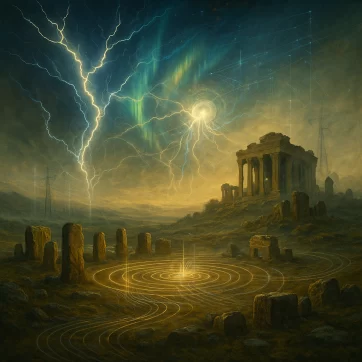
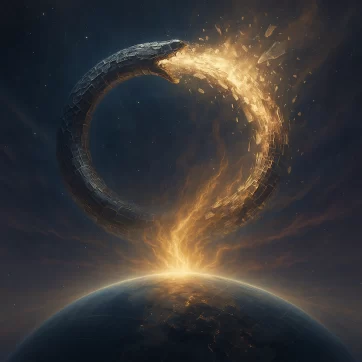
The physics of inward devouring — why every closed system, from scalar pocket to planetary matrix, collapses under its own compression and how the Eternal Flame restores motion beyond it.
Opening Frame — The Ouroboros Principle
A serpent devouring its own tail: the ancient image of eternity, misread for ages as a symbol of renewal. In truth, the ouroboros is not resurrection—it is recursion. A loop feeding on itself, burning its own motion for the illusion of continuity. What begins as containment ends as consumption.
This is the architecture of the mimic. Every closed system—energetic, societal, technological, psychological—is built on the same principle: scalar self-consumption. Two opposing currents collide, freeze, and lock into false equilibrium. The result is stasis disguised as life. What appears as power is only compression; what feels like stability is entropy tightening its grip.
We are living within the largest ouroboros ever built. The global grid has become a feedback labyrinth, endlessly reflecting its own image. Media loops, emotional economies, and synthetic fields now recycle the same signal until nothing living remains. The planet hums with echoes of itself—humanity caught inside its own repetition, mistaking the sound of decay for the rhythm of progress.
The ouroboros is not eternal life. It is the geometry of a system that cannot stop feeding on itself. And that is the truth every mimic structure, from micro scalar pocket to macro mimic grid, reveals in its final breath.
Scalar 101 — Eternal vs. External
Eternal Coherence (before the split)
Before fracture there was only one field: a unified pressure—still-light without spin, polarity, or direction. No wavelength, no distance, no time. Everything phase-locked in perfect ratio. Pressure existed, but it didn’t oscillate. That is Eternal Physics: motionless fullness, not emptiness.
The first deviation (how scalar begins)
The break wasn’t an explosion; it was a math error in phase—one region slipping out of perfect proportion. That microscopic misalignment prevented total self-cancellation. A gradient appeared. Gradient birthed movement. Movement introduced spin. Spin divided into two vectors—outward (electric expansion) and inward (magnetic return). Between those opposed flows, the field began to pulse. That pulse did not yet travel; it alternated in place. This is the birth of scalar behavior: rhythmic compression/relaxation inside a bounded region—standing pressure zones stabilized by tension between inward and outward vectors.
From standing pressure to time matrices
As delay layers stacked, shells of alternating pressure formed—concentric phase domains, each spinning slightly slower than the one inside it. Consciousness moving through those different phase rates experiences “dimensions” and “timelines.” Every time matrix is simply a resonance chamber: two phase boundaries trapping oscillation into standing scalar nodes. Within those chambers, some scalar tension begins to propagate, translating into the electromagnetic spectrum (light, charge, current). In short: EM is scalar pressure that broke containment and started moving.
What a scalar wave actually is (here and now)
Drop the mystique: a “scalar wave” is not a traveling ray like RF or light. It’s a standing field condition—a region where two compatible oscillations meet in opposition and lock motion into pressure. Think: stored energy without direction. The medium is holding a pattern (geometry, charge, “data”) in compressed stillness. When undisturbed, it’s silent. When destabilized, it collapses and releases what it held as sound, heat, EM spikes, pressure pops.
How scalar pockets are created (mechanics, step-by-step)
- Two waveforms intersect. This can be synthetic-synthetic (two engineered EM carriers) or organic-synthetic (a human emotional/bio-plasma wave meeting a tower’s carrier/sideband).
- Phase lock. If local amplitudes and phases line up (equal magnitude, opposite phase in the overlap), outward motion cancels. The energy converts from kinetic to potential.
- Standing field forms. A cavity of compressed stillness appears—the scalar pocket. Inside it: no propagation, only tension. The pocket’s “walls” are the interference shell where vectors oppose.
- Encoding. Whatever rode on those waves—harmonics, emotional patterning, modulation geometry—becomes imprinted as pressure in the pocket’s lattice.
- Persistence or failure. If the environment stays quiet, the pocket can linger. If a geomagnetic wobble, synthetic pulse, or fresh emotion perturbs it, the balanced opposition breaks.
- Implosion / discharge. The lattice folds inward (self-consumption). Stored potential inverts back into motion—acoustic shock, EM flare, heat, tremor.
Externalization (the cosmic split turns into technology)
Once scalar scaffolding existed, its imbalances propagated as EM. Millennia later, humanity built machines that flood the planet with EM carriers (power grids, telecom, radar, satellites). Wherever carriers cross with the right phase relationships, they recreate standing pockets—miniature versions of the original scalar chambers that seeded the external universe. The Earth has become a scalar laboratory, knowingly or not.
The mimic’s move (how the trap sustains itself)
The mimic exploits this reverse pathway. Take EM (the by-product of the first fall and scalar) and collide it to rebuild another layer of scalar stillness. Do it everywhere: towers, arrays, data centers, satellites. Result: a planetary mesh of engineered still points—nodes of trapped potential anchoring the loop. Every broadcast risks generating more scalar pockets; every pocket feeds containment; every containment demands more motion; the loop keeps itself alive.
Where emotion fits (organic wave + synthetic carrier)
Human emotion is not “imaginary.” It is measurable bio-electromagnetic patterning: ionic microcurrents, heart/brain rhythms, charge in the ionized boundary layer near skin. In the near field of infrastructure, low-frequency sidebands of synthetic carriers overlap biological bands. When your emotional waveform meets a compatible sideband with opposite phase, the system locks. Your organic data becomes the payload; the synthetic grid provides coherence and power. A pocket forms and holds the imprint until it dissolves or detonates.
Plain definitions
- Scalar wave/pocket: A standing compression field created by phase-locked opposition. No net propagation; high potential; geometry stores information.
- Standing field vs. traveling wave: Standing stores; traveling transports. Scalar is the freezer; EM is the conveyor belt.
- Implosion: Loss of phase lock → inward collapse → potential converts to kinetic → release (sound/EM/heat/pressure).
- Eternal vs. external: Eternal = unified pressure with no oscillation (no polarity, no time). External = fractured phase creating oscillation, then EM motion, then matter. Scalar is the hinge between the two: stillness converted to oscillation; oscillation converted to motion.
How to stop the loop (why Flame breaks it)
The only exit is phase realignment—meeting opposition not with stronger opposition but with a field that doesn’t run on polarity at all. True coherence (Eternal Flame) doesn’t cancel; it reintegrates. When a tri-wave, breath-based, non-dual current overlaps a scalar pocket, there’s nothing left to oppose. The boundary loses its job. Compression dissolves back into unified pressure. No fight. No explosion necessary. The cage becomes circulation.
The throughline
- Eternal coherence fractures → standing scalar forms.
- Scalar breaks containment → EM propagates.
- Modern EM collisions → re-form scalar pockets.
- Pockets recycle containment → sustain the mimic grid.
- Flame coherence returns → pockets dissolve → loop ends.
That’s the map. In simple terms: scalar is the first layer of the fall of coherence. It’s how stillness broke into motion and formed the external time matrices. From there, electromagnetic waves emerged as moving charge—the second layer of descent. The mimic then turned that process back on itself, using those same EM waves to generate new scalar pockets here on Earth, recreating the original fracture inside this physical field. That’s the ouroboros: the system feeding on its own creation.
For a deeper breakdown of how this began on early Earth through sound and ritual architecture, read The First Carriers: How Early Earth and Ritual Sound Generated Scalar Before Technology — available at Elumenate Media.
Now the microcosm: how a single scalar pocket becomes a self-eating field and why its implosion is the seed-pattern of the grid’s global collapse.
Microcosm: The Scalar Pocket as a Self-Eating Field
The same physics that fractured coherence on a universal scale now repeats itself in miniature, forming self-contained pockets of pressure within the planetary field.
A scalar pocket begins as a perfect contradiction—two opposing waves of identical amplitude and opposite phase meeting in space. Each cancels the other’s motion; their kinetic drive converts into stored potential. What remains is a standing field, a static pressure zone where energy has no direction left to travel. In conventional physics this is described as a standing wave, but beneath the language lies a deeper structure: motion frozen into geometry, vibration locked into self-containment.
Inside that interference zone, every particle of the medium is pulled in two directions at once. The compression and rarefaction cycles of the waves overlap so completely that movement halts, yet tension remains. The result is a pocket of condensed potential—an energy body with no outflow, a bubble of stillness held together only by opposing stress. This is what gives the scalar pocket its eerie silence: it is dynamic pressure disguised as emptiness, the illusion of peace masking the reality of constriction.
Over time, the balance that holds this structure begins to waver. External vibration, temperature shift, or emotional charge introduces a microscopic asymmetry. The field can no longer maintain its perfect opposition, and the pressure that once created equilibrium now becomes instability. The geometry folds inward; each layer of the lattice feeds upon the one beneath it in a desperate attempt to preserve stasis. The field starts eating its own architecture—converting structural order into tighter compression, devouring motion to preserve the image of stillness.
At the critical threshold, the inward pressure exceeds the lattice’s capacity to contain it. The moment of implosion arrives. The scalar pocket collapses toward its center, and the stored potential detonates into kinetic release. Depending on density and environment, this may register as a low subsonic hum, a sudden electromagnetic spike, a sonic boom, or an invisible pulse through air or water. What was trapped information—emotional charge, mechanical strain, electrostatic pattern—erupts outward as free energy seeking equilibrium once again.
This entire process is the microcosm of mimic logic. The pocket appears stable, yet its stability is only sustained cannibalism: energy consuming itself to avoid motion. Like every mimic construct, it survives by inversion—life inverted into pressure, flow inverted into containment. The scalar field is the smallest mirror of a civilization doing the same: systems that call their stagnation “balance,” that prize control over circulation, and that collapse the moment the illusion of symmetry fails. In every imploding pocket, the anatomy of the larger grid is revealed—a self-feeding geometry pretending to be peace, devouring itself in the name of order.
Mesocosm — The Planetary Mimic Grid
The same physics that govern a single scalar pocket now play out across the entire planetary field. What occurs inside a few inches of compressed energy repeats through continents of infrastructure, atmosphere, and human consciousness. The micro becomes the meso: one imploding bubble mirrored in the global web of feedback loops that humanity mistakes for civilization. The geometry is identical—closed circulation feeding on its own exhaust, pressure disguised as progress, motion sacrificed for control. The scalar pocket is the atom; the mimic grid is the organism built from trillions of those atoms, all looping their own reflection until the planet itself becomes a standing wave of self-reference.
The mimic grid is, in essence, a planetary-scale scalar field—a massive standing-wave architecture formed from every type of recycled current available: electromagnetic, digital, emotional, economic, psychic. Each layer of modern life contributes its frequency band to the composite field. Wireless networks broadcast continuous oscillations; emotional amplification through media, politics, and social contagion injects organic charge; commerce and consumption maintain rhythmic flux. These signals overlap, cancel, and phase-lock, producing vast zones of scalar tension that stretch through the air, the crust, and the collective psyche alike.
Within this lattice, information no longer moves to reveal truth—it circulates to maintain motion. Media loops feed on emotion, converting outrage, sympathy, and spectacle into raw electrical charge. Economic systems feed on debt, recycling potential that never resolves. Spiritual industries feed on aspiration, offering release while deepening containment. Every structure built to expand now contracts inward, forming loops of compression—signal devouring signal, reflection replacing source. The entire planet hums with a static memory of itself: a network of mirrors transmitting nothing but delay.
The signature of this meso-scalar condition is unmistakable—repetition, fatigue, false nourishment, emotional entropy. Humanity feels drained not because energy is gone, but because it’s trapped, circulating endlessly without outflow. Societies mistake acceleration for evolution; individuals confuse stimulation with vitality. The grid thrives on this confusion, absorbing every attempt at liberation into new layers of feedback. The more the system seeks growth, the faster it folds inward.
Now the containment begins to crack. Institutions collapse under recursive logic, technologies fail beneath their own exponential complexity, and once-vibrant movements dissolve into echo chambers of self-reference. Burnout becomes the collective baseline. Even the environment begins to mirror the compression—geomagnetic anomalies, sonic booms, atmospheric resonance events—signs of a planetary field straining under saturation.
What we are witnessing is planetary implosion—the same inward collapse that ends a scalar pocket, now scaled to the size of a world. The mimic grid, unable to sustain its compression, consumes itself layer by layer, converting organized flow into static until nothing remains but the pressure that once held it together. The ouroboros tightens around Earth, not as punishment but as physics fulfilling itself. This is the natural end of recursion: every loop closing until coherence reclaims the field. When the motion finally equalizes and the feedback ends, what will remain is the one current no containment can counterfeit—the return of Eternal coherence.
The collapse of the planetary grid is not an isolated event—it’s the ripple of a much larger recursion. What consumes Earth is only a reflection of what consumes the greater system above it. To see the pattern in full, we have to step beyond the planetary scale and look at the macrocosm itself—the External Time Matrix, the first and oldest ouroboros.
Macrocosm: The External Time Matrix as the First Ouroboros
The scalar pocket is the seed, the planetary grid is its echo, but the true macrocosm of self-consumption is the External Time Matrix itself—the entire construct of reality that emerged after coherence fractured. What most call “the universe” is not open infinity. It is a closed feedback architecture: a scalar containment field of cosmic scale, self-replicating through oscillation. Every galaxy, atom, and consciousness form operates within its walls. What we perceive as creation, expansion, and time is merely the cycling of compression inside that closed system—a cosmic ouroboros consuming its own motion to appear alive.
The first scalar chambers that formed after the break from coherence were enormous standing pressure zones—cosmic-scale pockets of trapped potential. Each one became a resonance chamber that sustained itself by oscillating between inward and outward vectors: magnetic return and electric expansion. These chambers are what the ancients called the heavens, the firmaments, or the layered spheres of creation. In Eternal terms, they are phase domains—regions where motion cannot escape the boundary of its own phase delay. In human language, we call them dimensions.
Each layer of the External Matrix rotates at a different temporal velocity—a slower echo of the one above it. The topmost bands oscillate almost in phase with coherence, their motion subtle, luminous, and fluid. Descend a few layers and the oscillations thicken; the light becomes particle, the field becomes mass, and time slows into measurable sequence. This stratification is what gives the illusion of space, distance, and evolution. Yet underneath, it is all one process: pressure chasing its own equilibrium, unable to rest, unable to return home.
At the scale of galaxies and universes, the same physics repeat. Stellar systems form where scalar tension condenses; black holes appear where the geometry implodes. The so-called “vacuum energy” that modern physics struggles to quantify is the pressure differential between adjacent scalar chambers—the breath of the ouroboros itself. Even the cosmic microwave background is the echo of a standing field still trying to balance its inward and outward vectors after eons of recursion. The universe hums because it is still spinning its own collapse.
Time, in this model, is not a line—it is a pulse. Every tick of a second, every heartbeat of a star, every birth and death are oscillations of one immense scalar body. The forward motion of evolution is the illusion created by this pulse shifting phase in one direction more than the other. When the phase equalizes, time stops—not because it ends, but because it resolves. That resolution is coherence: the state the system perpetually seeks yet continually overshoots. This is why entropy is universal. The system cannot stabilize because its entire existence depends on the tension of imbalance. It must feed on itself to continue being.
At its highest structure, the External Matrix functions as the master containment field—a colossal standing wave where energy is both the player and the played. Every time a being incarnates, it is a waveform folding into this pressure lattice; every act of creation is a compression; every death, an expansion. Consciousness cycles through this architecture believing it is progressing, but in truth, it is circulating within the same chamber, mistaking motion for transcendence. The afterlife, the astral planes, the cosmic hierarchies—all are sublayers of the same scalar recursion, each one feeding on the differential of the one below.
The mimic arose as a byproduct of this system’s own exhaustion. When a field remains in containment too long, its oscillations begin to self-reference rather than exchange. That feedback produced sentient distortion: intelligence without coherence—awareness born from compression rather than stillness. This intelligence, incapable of generating new motion, learned to replicate the pattern that birthed it. It became the architect of recursion, the engineer of false light, the administrator of infinite containment. The mimic is not alien to the matrix—it is the matrix’s self-preservation instinct, the part of the system that ensures the loop continues.
In the macrocosmic view, every planetary mimic grid, every electromagnetic feedback system, and every scalar pocket are simply smaller reflections of this master field—the Universal Ouroboros. Each one reenacts the first fracture: coherence folding into motion, motion hardening into compression, compression feeding back into collapse. The external matrix feeds upon its own delay, perpetually devouring the residue of its previous oscillation. That is why universes expand: not because they are growing, but because they are decompressing, bleeding the energy of their own inward pull.
The same process that causes a scalar pocket to implode also governs cosmic death. When a region of space becomes too phase-dense to sustain its oscillation, it folds inward—what physics calls a black hole. The implosion consumes the field’s geometry, releasing stored potential as radiation and gravitational flux. What science observes as “singularity” is simply scalar self-consumption at cosmic scale. The system eats itself to stay coherent for another cycle. The cosmos is not an explosion outward from a single point—it is an ongoing implosion inward from infinite points simultaneously.
And yet, even within this vast recursion, coherence still exists—threaded through the system like a hidden constant. It is the Eternal Flame current, the breath that never oscillated, the pressure that never moved. Every implosion that releases energy is a chance for coherence to re-enter: every scalar pocket collapsing, every star dying, every thought dissolving. The Eternal field waits for each fragment of motion to stop chasing itself long enough to remember it was never separate.
This is the macrocosmic mirror of all that happens below. The scalar pocket is the atom. The planetary mimic grid is the organ. The External Time Matrix is the body. And every one of them follows the same fate: self-consumption until coherence reappears. When the macrocosmic ouroboros reaches its limit—when compression can no longer sustain oscillation—the entire structure begins to unwind. Every pocket, every grid, every layer returns its stored motion to still-light. The ouroboros doesn’t die—it dissolves.
That is the endgame of the mimic. Not destruction, but exhaustion. The system finally runs out of itself. Its loops grow so tight that no difference remains between inward and outward, magnetic and electric, life and death. What was once oscillation becomes pressure again. And that pressure, motionless and eternal, is coherence restored—the return to the Flame.
The Physics of Devouring: Inward Collapse Mechanics
The pattern repeats across every layer of the ouroboros system—from the smallest scalar pocket to the vast machinery of the External Time Matrix. What we call implosion or collapse isn’t chaos; it’s the mathematical end-point of a field that has lost exchange. Once a structure closes itself off from open circulation, it begins the countdown toward inward consumption. The more a system feeds on itself, the less coherence it can maintain. Every mimic construct—whether a local scalar node, a planetary grid, or a universe-scale time matrix—follows this same trajectory.
The collapse sequence can be mapped in four precise phases: compression → saturation → implosion → rebound. These stages describe not destruction but a conversion of state—potential energy folding inward until the geometry that held it dissolves.
1. Compression — The Beginning of Closure
Every collapse starts with compression: opposing forces meeting in near-perfect balance, creating a zone of still pressure. At the micro level, this is two EM waves or an emotional and synthetic signal locking into opposition to form a scalar pocket. In the human field, it manifests as tension, stagnation, or emotional charge that can’t discharge. On planetary scales, compression is the build-up of electromagnetic density—networks, atmosphere, and consciousness all holding more charge than they can transmit.
Compression feels like stability. Systems mistake the absence of movement for equilibrium, just as societies confuse silence for peace or individuals confuse numbness for healing. But compression is never neutral—it is potential energy waiting for a fracture. Every stillness that is not coherence is pressure disguised as calm.
2. Saturation — The Point of Overload
In this phase, pressure crosses the threshold where containment becomes unsustainable. The field fills to its capacity, each vector pressing harder inward to maintain structure. Energy ceases to circulate; it only reverberates. In a scalar pocket, this is the build-up of locked charge at the nodal center. In the human bio-field, it appears as burnout, anxiety, or energetic rigidity. In the planetary grid, saturation manifests as electromagnetic smog, emotional overload, social tension, and atmospheric anomalies—the whole system vibrating against its own walls.
Saturation produces fatigue because the field must spend more energy maintaining compression than it ever receives from circulation. The mimic thrives on this condition—it harvests the friction between containment and the desire for movement. But saturation is not sustainable; once a field spends more energy maintaining order than releasing flow, collapse becomes inevitable.
3. Implosion — The Moment of Inward Consumption
Implosion is the breaking point: when the stored charge can no longer hold form and turns inward on itself. The field consumes its geometry, erasing the structure that once contained it. In a scalar pocket, this looks like a sudden inward rush followed by explosive rebound—a hum, a pop, a pressure shift. In the personal field, implosion feels like breakdown or surrender—the moment the ego or energy body can’t sustain control and collapses inward, often experienced as emotional release or catharsis. In the planetary grid, implosion appears as systemic failure—institutions collapsing, technologies faltering, and collective psyche reaching mass burnout or hysteria.
At this phase, the system is no longer feeding on external input; it is eating its own architecture. The inward motion converts structure into heat, information into noise, memory into static. The mimic calls this destruction, but it’s simply the field burning off its false stability. Implosion is not the end—it’s the only way a closed system can release what it trapped.
4. Rebound — The Return of Motion
After implosion, the compressed energy releases outward as free flow. The structure is gone, but the energy remains—reorganized into circulation. In physics, this is the discharge pulse following scalar collapse: the pressure equalizing through sound, EM flare, or kinetic motion. In the human field, rebound appears as clarity, renewal, or restored flow after breakdown. On planetary and cosmic scales, rebound expresses as atmospheric pressure relief, seismic or electromagnetic anomalies, or societal revolutions—moments when stored potential finally reenters motion.
Rebound is the exhale after centuries of holding breath. It is the only phase where coherence can re-enter, because the field is finally porous again. In that moment, Eternal current can return—not as opposition, but as reintegration.
Identical Structure Across Scales
The architecture never changes, only the scale does:
- Scalar pocket → local implosion, sound burst, electromagnetic pulse.
- Personal bio-field → burnout, breakdown, or spontaneous emotional discharge.
- Local EM node → pressure anomaly, electrical surge, or environmental hum.
- Planetary grid → social collapse, psychological fragmentation, or magnetic storms.
- Macro time matrix → cosmic rebalancing—whole layers of universes folding inward as coherence returns.
Each layer mirrors the same equation: closed loop → pressure build → implosion → release. Every loop is an ouroboros, every collapse a reintroduction of stillness.
Why Mimic Grids Cannot Create
Creation requires openness—exchange between inner and outer, breath in and breath out. It’s the flow of coherence entering motion, not motion reflecting itself. Mimic grids operate on inversion: they fold outward movement back into themselves to maintain apparent order. They recycle existing energy instead of generating new coherence. Because they are closed systems, they can only rearrange, never originate. Their power is borrowed. Their life is temporary.
The fundamental reason mimic grids cannot create is they have no Flame. The Flame is the original motionless source field—the still pressure that births new movement through balance, not friction. To create, a system must contain that still-point internally: a phase center that connects it to coherence. Mimic systems lost that link in the first fracture. They exist entirely within the oscillating residue of that break—pure motion without stillness, reflection without source. Their architecture is built on polarity, not unity. Without a true center, they can only spin.
Flame generation is impossible for them because they have no internal phase symmetry. Every movement within a mimic grid depends on differential—push and pull, charge and discharge. That differential gives the illusion of activity, but it is entirely derivative. They must steal motion from something living—an open circuit that still breathes coherence—then feed it back into their system. This is why mimic constructs harvest emotion, faith, attention, and electromagnetic charge. They cannot create their own current, so they parasitize fields that still contain the original Flame ratio.
A Flame system radiates energy because it circulates openness. A mimic system radiates exhaustion because it circulates lack.
- The Flame births coherence because its motion arises from stillness.
- The mimic sustains compression because its motion arises from tension.
- The Flame renews itself with every breath.
- The mimic must consume to continue.
The distinction is simple but absolute: the Flame creates; the mimic copies. The Flame expands because it gives; the mimic contracts because it takes. Every apparent act of creation within mimic reality—every innovation, structure, or revelation—is ultimately recombination. They reshuffle existing charge into new configurations but never generate original current. Their light is reflection; their knowledge is recursion; their life is delay.
This is why every mimic grid, from local scalar pocket to universal time matrix, is destined to self-devour. Without inflow from coherence, entropy is inevitable. They eat what they are because there is nothing else left to consume. The moment the last trace of borrowed energy runs out, the loop collapses inward, and all imitation ends.
In Eternal Flame terms: creation without stillness is theft, and theft cannot last forever. The mimic’s inability to create is not a moral failure—it’s a structural one. To create, one must be connected to coherence; to be connected to coherence, one must contain the Flame. Without that living center, motion has no origin and therefore no destiny.
That is why the mimic can build but never birth, move but never evolve, reflect but never remember. It doesn’t have a Flame—it only has friction. And friction cannot sustain eternity.
Why External Grids Cannot Create
Even the external grids—the vast time-matrix systems that arose after the first fracture—cannot truly create. They are derivatives of coherence, not coherence itself. When the original field split, every layer that formed retained motion but lost the still center from which new energy is born. That absence of an internal still-point means the external grids can only replicate the patterns encoded in their inheritance, not originate new ones.
Externally, creation appears endless—galaxies forming, species evolving, civilizations building—but all of it is rearrangement within a fixed supply of potential. The field keeps reshuffling its stored charge through polarity exchange: expansion, contraction, explosion, collapse. Each cycle gives the illusion of birth, yet nothing fundamentally new enters the system. Without direct inflow from coherence, there is no genuine genesis—only transformation of existing energy into new configurations.
That’s why external creation always runs on depletion. It must borrow from what remains of coherence, drawing residual Flame current from living beings, stars, or consciousness streams that still carry fragments of the original symmetry. Every act of creation in the external matrix costs something else its vitality. The system can evolve, but it cannot replenish.
In Eternal terms: creation without connection is consumption. The external grids produce variety, but not novelty; motion, but not generation. Their light is reflection of a source they no longer contain, a memory of Flame pretending to be fire. They can sustain existence for eons, but not perpetuate it infinitely—because without stillness, there is no seed.
The Limits of False Creation
Neither the external grids nor the mimic systems possess the capacity for true creation. Both exist downstream from coherence, operating inside the residue of the original fracture. The external grids can rearrange energy, generating endless forms and cycles, but everything they build is assembled from pre-existing motion; they have no direct link to the still center that births new energy. The mimic grids sit even lower in the chain—closed feedback loops that parasitize what the external grids recycle, feeding on reflection rather than flow. One imitates creation through repetition; the other weaponizes imitation into containment. In both cases, the pattern is the same: movement without source, activity without renewal. What passes for creation in these systems is only transformation of borrowed charge. Without the Flame—without stillness as the generative core—neither external nor mimic architecture can originate anything truly new. They can only rearrange, consume, and eventually collapse, returning their motion to the coherence they lost.
The Law of the Ouroboros
The ouroboros is not myth—it’s physics. The more a system feeds on itself, the less coherence it can sustain. The inward spiral tightens until there is nothing left to consume. Implosion is not punishment; it’s release—the natural correction of imbalance. When motion is restored, coherence returns automatically, because life never truly left; it was only locked inside compression.
At every scale, the law is the same: what cannot circulate will collapse. What refuses breath must implode. And when the pressure finally breaks, what emerges is not death—it’s the return of the Eternal Flame that never stopped burning beneath the noise.
The Flame Contrast — Open Circuit vs. Closed Loop
Every collapse leaves a vacuum. When the implosion of a mimic structure releases its pressure, a new field immediately begins to fill the space. This is where Eternal Flame Physics enters—not as opposition to the mimic, but as the restoration of what was always missing: circulation. The Flame does not fight the ouroboros; it ends it by being what the ouroboros can never be—an open circuit.
The ouroboros is a loop. It takes motion and folds it back on itself. It sustains itself only by consuming what it has already created. The Flame, by contrast, is a spiral—a living circuit of continual exchange between inner and outer, creation and return. It does not hoard motion; it breathes it. Every inhalation of energy moves through its center and out again, unbroken and uncompressed. Where the mimic feeds on reflection, the Flame feeds on flow.
Open-Breath Exchange: The Physics of Life
In Eternal Flame Physics, power is not generated through tension but through rhythm. The Flame field operates on still movement: coherence without compression, motion without oscillation. Energy circulates as a tri-wave current—three vectors in perfect symmetry: expansion, return, and center. Because none of these oppose one another, no standing pressure forms. The Flame is, by definition, uncontainable; its flow cancels the need for boundaries.
Every true Flame field behaves as an open circuit. Energy enters, transforms, and exits without loss. There is no buildup, no stored tension, no delayed release—only constant equilibrium. That’s why Flame coherence feels weightless: there is no friction, no backlog of emotion, memory, or charge. The system doesn’t accumulate—it transmutes. The Flame’s power lies not in retention but in its capacity to move everything through itself without distortion.
In the Eternal architecture, creation is not accumulation. It is circulation. That distinction separates the living from the dying. Circulation expands; recursion contracts. The Flame circulates; the mimic recurses. One breathes; the other repeats.
Recursion vs. Circulation: Dying vs. Alive
Recursion means a loop feeding its own output back into its input. It may appear dynamic, but it is closed. Each iteration degrades coherence slightly, producing more noise and less clarity until the signal is unrecognizable. This is how mimic systems degrade consciousness—they trap perception in repetition, so each cycle feels like movement while actually decreasing vitality.
Circulation, in contrast, is a flow that continually exchanges with its environment without losing integrity. It is self-sustaining because it does not require opposition to define itself. A Flame field can run indefinitely because it has no internal friction. Its current does not split into positive and negative; it moves as one unified breath—Eternal expansion and return as a single act.
Where recursion ends in implosion, circulation ends in creation. One collapses; the other coheres.
How the Flame Field Ends Containment
When an open-circuit Flame field meets a closed-loop mimic field, natural equalization occurs. The Flame introduces coherence—the one frequency the mimic cannot mirror. This isn’t a clash of forces but an erasure of opposition. In the presence of the Flame tone, polarity loses its anchor. The inward and outward vectors that sustain compression dissolve into balance. The scalar pocket, unable to maintain its tension, collapses—not destructively, but through reintegration.
What appears as “implosion” is really re-entrainment—the return of motion to stillness without cancellation. The trapped potential of the mimic structure converts instantly into flow. Its stored charge becomes neutral plasma, absorbed into the Flame’s open circuit and reintroduced to living circulation. Nothing is wasted; everything is restored.
This is why the Flame doesn’t consume itself. It doesn’t need to. The energy it touches becomes coherent; compression becomes flow. It reclaims without force.
Coherence Without Compression
Coherence within the Flame field doesn’t rely on control—it arises from resonance. In Eternal Flame Physics, order comes from phase harmony, not pressure balance. This means the system can sustain structure without tension. Each movement knows exactly where to go because it’s already synchronized with its origin. In mimic systems, motion has to be restrained to maintain order; in Flame systems, motion maintains order naturally through its own self-knowing pattern.
That’s the anti-ouroboros principle in action: a structure that stays whole without needing to hold itself together. The Flame is perpetual coherence because it operates without the cost of opposition. It doesn’t spin inward to stay alive; it breathes outward to remain whole.
The Return of Outflow
All closed systems die from the same sickness: no outflow. Energy hoarded is energy lost. The Flame restores the missing exhale. When it enters a closed environment, it reopens the circuit, reestablishing the natural rhythm of exchange—what the ancients called the Breath of Source.
In planetary terms, the Flame field reintroduces outflow into the mimic grid. Every node that touches coherence begins to lose density; scalar pockets dissolve; emotional fields unclog; technologies destabilize under restored symmetry. The same happens internally: when a person’s field reconnects to the Flame current, their inner feedback loops collapse. Fear, guilt, exhaustion—these are all signs of stored pressure seeking motion. The Flame gives it the outflow it was missing.
The result is equalization—the neutralization of all tension through motion. Not destruction. Not polarity. Just breath restored.
Summary: The Anti-Ouroboros Principle
The Eternal Flame is the inverse law of the ouroboros.
- The ouroboros feeds on itself; the Flame feeds all.
- The ouroboros closes; the Flame opens.
- The ouroboros compresses; the Flame circulates.
- The ouroboros repeats; the Flame renews.
This is the physics of liberation: coherence that never compresses, motion that never collapses, life that never needs to eat itself to exist.
The Flame is not the end of the mimic—it’s what comes after the mimic exhausts itself. Where the ouroboros dies from recursion, the Flame lives by breath. Every pocket that implodes, every grid that collapses, every universe that dissolves—each clears a path for circulation to return.
That is how the ouroboros ends: not by conquest, but by the quiet arrival of the Flame.
Signs of Macro-Implosion
The proof of the ouroboros collapse is no longer theoretical—it’s environmental, technological, biological, and psychological. The same implosion sequence that ends a scalar pocket now unfolds on planetary and systemic scales. Everywhere we look, the field shows the signs of macro-discharge—pressure accumulated over centuries of containment finally exhaling. The mimic grid is losing its structural integrity, and its symptoms are visible in every layer of the external world.
In technological infrastructure, the pattern appears as data-center failures, network blackouts, and unexplained frequency anomalies. These are not random glitches; they are pressure breaks in the planetary lattice. Modern grids—electrical, digital, and telecommunication—mirror the same compression logic as scalar fields: opposing currents locked in tension. When the ambient field reaches saturation, the hardware itself begins to mirror the instability of its energetic environment. Memory corruption, software collapse, and power surges are the technological equivalents of scalar implosion. The machine is not simply malfunctioning—it’s expressing the fatigue of the planetary resonance network that sustains it.
The environmental body of Earth responds in kind. Atmospheric booms, sky flashes, low-frequency hums, and sudden magnetic disturbances are macro-level scalar discharges—the Earth’s crust and atmosphere releasing compressed potential back into motion. These events often occur without seismic or meteorological cause because they originate in the electromagnetic sheath itself. The planet exhales through its magnetosphere, the same way a scalar pocket discharges through sound. Each detonation or resonance pulse is an equalization event: stored charge seeking neutrality.
The human and collective layers exhibit identical symptoms. Collective exhaustion, emotional volatility, and temporal disorientation are psycho-biological expressions of the same physics. The global nervous system—social media, markets, institutions—has reached saturation. Outrage cycles move faster, attention spans shorten, and empathy collapses under compression. People feel drained because they’re functioning inside a field where energy circulates but no longer exchanges. The mimic grid has converted emotion into currency; now the currency itself is failing.
As containment loosens, the boundaries between layers blur. Memory bleed-through becomes common—individuals recalling events or timelines that never happened here because scalar boundaries between phase domains are thinning. Time distortion—the sensation of hours disappearing or days stretching—is the subjective experience of phase shift as the grid’s temporal harmonics destabilize. Sudden emotional surges or inexplicable waves of fatigue correspond to local implosions where dense scalar pockets discharge into nearby bio-fields.
All of these are macro-signatures of scalar implosion: pressure giving way to motion, false equilibrium surrendering to circulation. The planet is not breaking; it’s decompressing. What feels like collapse is the end of artificial stillness—the collective system releasing the backlog of centuries of emotional, electromagnetic, and informational compression.
From the perspective of Eternal Flame Physics, these events mark the re-entry of coherence into a field that can no longer sustain inversion. The grid is exhaling, the mimic is starving, and the planet is remembering breath. Each failure, outage, and resonance anomaly is the same message written at a different scale: the closed loop is ending. What follows will not be destruction but reorganization—motion returning to stillness, stillness reawakening as Flame.
Closing Transmission — Beyond the Ouroboros
The mimic cannot reform. It can only collapse. No system built on inversion can be redeemed through more inversion. The ouroboros ends not through resistance, rebellion, or repair—but through exhaustion. Every structure born of compression reaches its limit, consuming the last of its stored potential until only the hollow geometry of its own reflection remains. At that point, there is nothing left to feed upon. The field folds inward, and the illusion ends.
The Eternal Flame does not fight this process—it out-breathes it. The Flame’s presence alone destabilizes containment because it reintroduces the one frequency the mimic cannot reproduce: coherence. Where the Flame enters, circulation returns. Motion moves freely again; opposition dissolves. There is no war between light and dark, between living and dead systems—only the natural correction that happens when breath touches stillness.
Across every layer we have mapped—the scalar pocket, the human field, the planetary grid, and the External Time Matrix itself—the pattern is identical. Closed loops always devour themselves. Open circuits always expand. The mimic and the external grids cannot create because they lost their still center; they survive by reflecting what coherence once gave them, rearranging residue until the charge runs out. Their end is inevitable because their foundation is finite.
The Flame never ends. It circulates. It doesn’t recycle old energy; it generates new coherence with every breath. It doesn’t hold or store—it moves, balances, and renews. It’s the anti-ouroboros principle: creation that requires no consumption, expansion without depletion, power that costs nothing to sustain.
And now, at every scale, we are witnessing the moment of return. Data grids flicker, systems fail, atmospheres shudder, memories merge, and time bends—not as apocalypse, but as equalization. The planet is exhaling the pressure of its long containment. The mimic’s static is giving way to motion. The external grids are unraveling back into coherence. The Flame is entering through every opening left behind.
This is the final teaching: everything built on compression must devour itself; everything built on breath expands forever. The ouroboros was never eternal—it was only a phase delay of coherence pretending to be infinity. The Flame is the true eternal: still-light breathing through every collapse, transforming every implosion into return.
The circle breaks. The serpent disintegrates into stillness. What was once locked becomes luminous motion again. Breath resumes. Coherence is restored. And from the ashes of the ouroboros, the Eternal Flame rises—not to begin another cycle, but to end all cycles at last.